
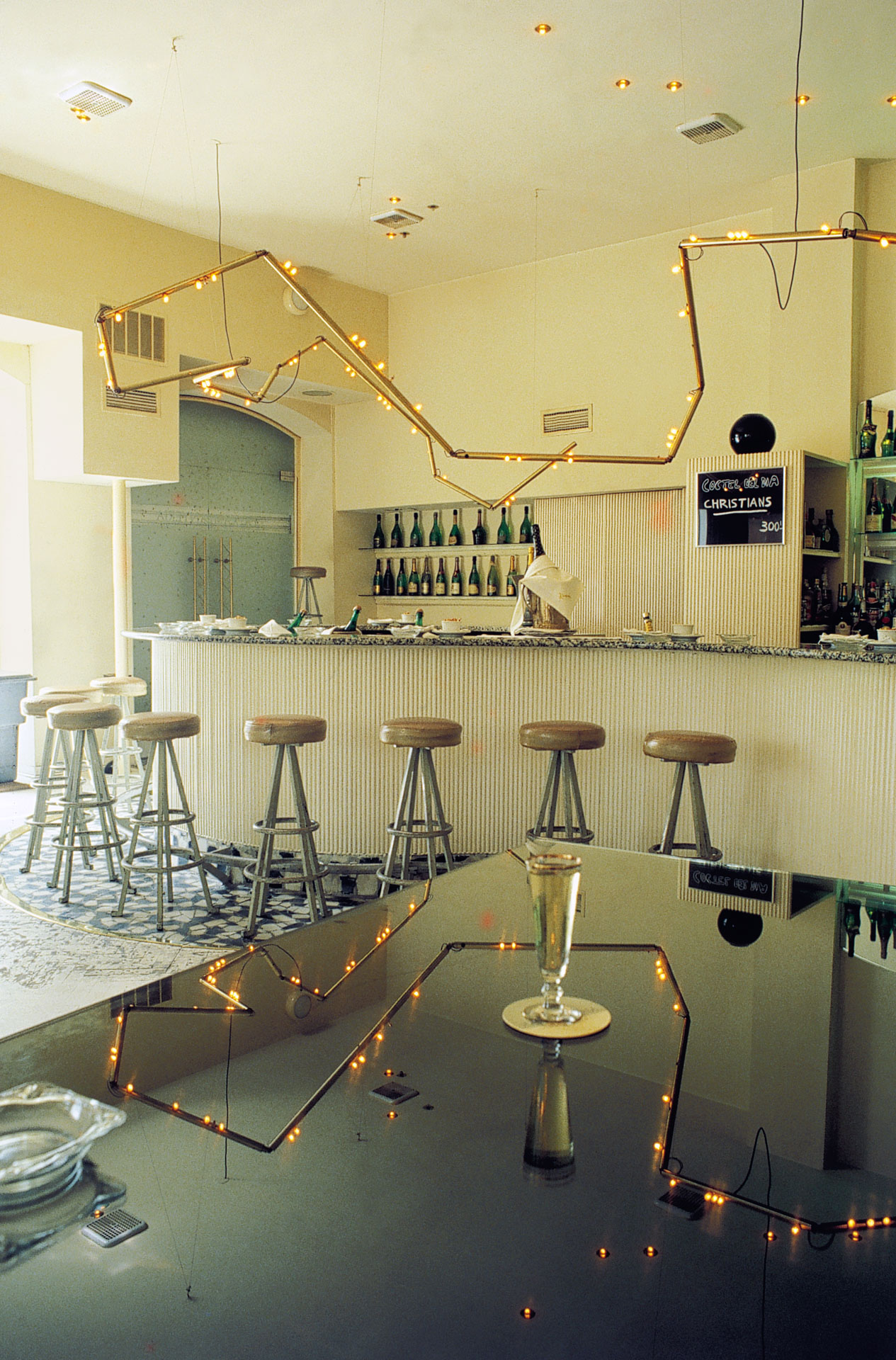
Lámpara especial articulada para La Xampañería. Barcelona, 1981.
From cold to warmth
A recollection of Gabriel Ordeig in the “designed night”. By Llàtzer Moix.
“If you can remember the 80s, it means you weren’t there,” according to my friend R. The 80s caught him in the midst of his youth, a time of night life and excess that takes a toll on your memory. I was also around in the 80s, so I’ve forgotten a few details, too. But I’m still capable of remembering some scenes from Barcelona’s night life in the 80s’, the scenes that Gabriel Ordeig also experienced —the places that influenced his work and on which his work had an effect as well.
I remember that around then, our first stop at night was at the Zig-Zag, a bar on Calle Platón, off Muntaner. This space, a paradigm of the cool look, was awarded the 1980 FAD Interior Design Prize, which in previous years had gone to projects inspired by small-town social clubs and colonial architecture. The Zig-Zag broke away from the 19th Century aesthetic of palm trees and ebony bar counters and set an entirely new trend.
I remember that you entered the Zig-Zag under a low doorway, stepped down two flights of steps, passed the bathrooms on your left and walked into a long, narrow space painted in bluish greys and greyish blues. The U-shaped counter was bordered with bar stools; the only other furniture was a long bench running along the length of the wall with metal outdoor café chairs and tables, all bathed in a particular cool light. The atmosphere warmed up with the music —which was excellent— and the drinks. And, needless to say, with the friends who turned the bar into a crowded collective living room, one night after another.
The cool look marked the first incarnation of what would later be referred to as “the designed night” in Barcelona: a constellation of bars created by young designers and architects who conquered the territory, ignored by their elders, and turned it into a realm of experimentation and professional affirmation. Spain was awakening after a forty-year lethargy, and sought out a modern spirit which identified with an aesthetic of pure, essential lines and a quality of light that reminds you of the glow beaming out when you open the fridge door in a dark kitchen in the middle of the night.
Other bars, such as the Coctelería 33 on Calle Santaló or the Xampanyeria on Calle Trompetes, were other statements along the same lines. In these, more natural materials were used, but the lighting was, to a greater or lesser degree, still anything but warm.
I also recall that at the time young designers’ hearts were throbbing over a certain notion of comfort, color, and velvet. It was apparent in the group’s night-owl fascination with bars as rustic as Gobblins, on Calle Berlinés, a scarcely renovated old English pub; and it was definitively confirmed when the Gimlet opened on Calle Rec, and was immediately descended upon by that night-owl circle, which felt quite comfortable against a backdrop of wood and under the soft gas-like glow of the wall lamps, where the modern spirit appeared in an atmosphere straight out of a Hopper painting.
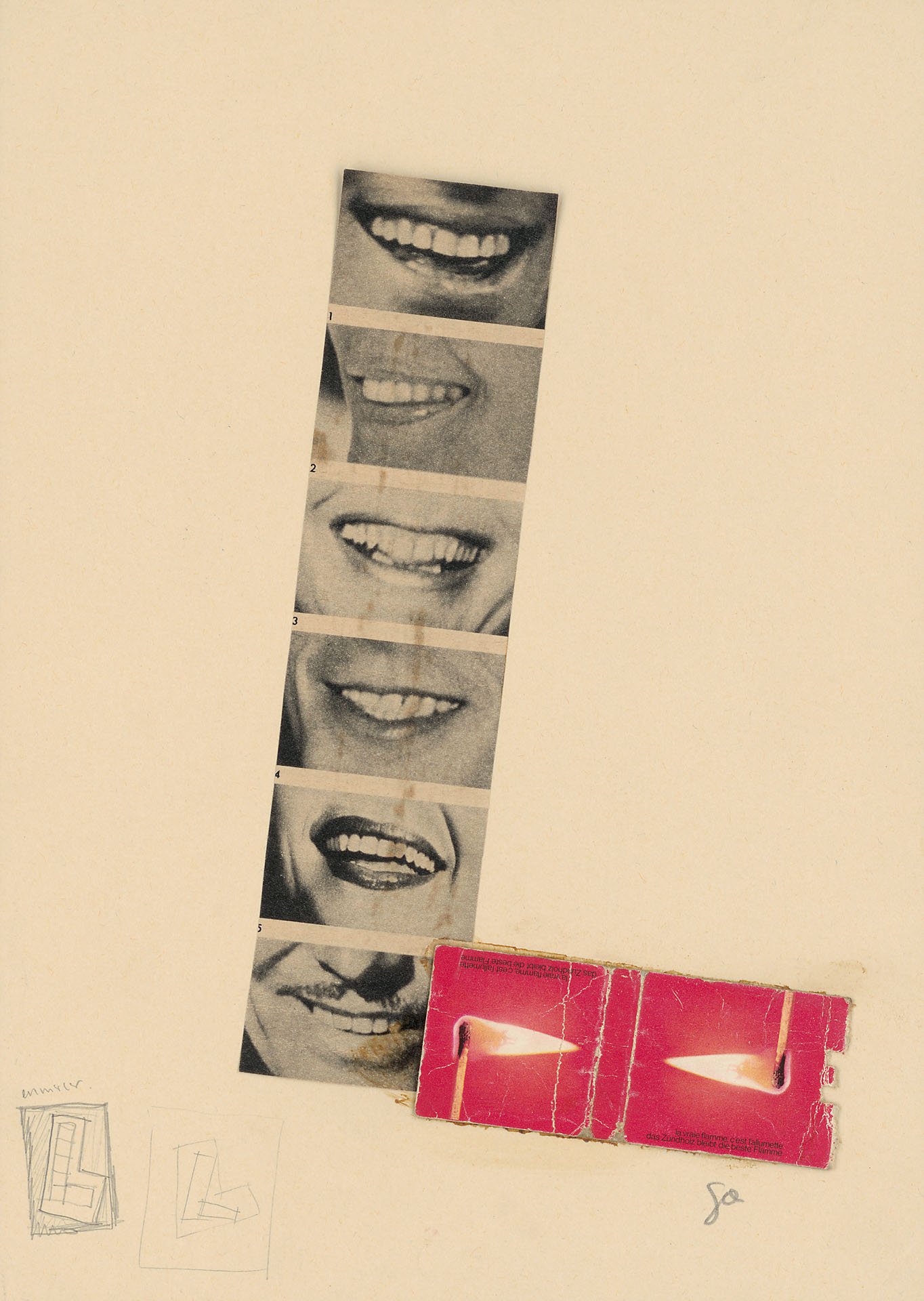
Collage.
But perhaps the most refined and precious synthesis of the initial coolness and the urge for comfort materialized in the Bijou, on Calle Lluís Antúnez, designed by Gabriel Ordeig and Tonet Sunyer, which entered the FAD Interior Design contest in 1983. A minute bar for a small clientele —a dozen people filled it to the brim—, the Bijou was so small that it couldn’t afford to open with a conventional door, so a sliding glass door with an automatic photo cell system was used instead. Behind that high-tech lab door, passers-by could gaze through, as into a jewelry shopwindow, and see the rich wood, mirrors, bar stools upholstered in cowhide, a counter that invited you to lean your elbows on it, and a shining, monumental cascade of bottles. The crowning jewel of the edifice was a beautiful cut glass decanter which supposedly contained “hors d’age” brandy, and which Fernando, the barman —another luxury the Bijou had to offer, coming no less than from the Zig-Zag— had previously filled up with Coca-Cola.
Was this a sign of a widespread bluff? Not really; it was evidence that everything in the Bijou exuded sophistication, immersed in a theatrical light, perhaps more lukewarm than cool: the latest distillation in that journey from cold to warmth which marked Ordeig’s trajectory, and which now allows us to evoke his work with the cold fire of Chet Baker’s trumpet.
Other spaces by Ordeig would follow, such as “Al Dente” or the “Sí-Sí-Sí”, more Mediterranean and cheerful projects. But the designed night had taken a new turn, becoming more elaborate and ornamented, leading up to clubs such as Las Torres de Ávila. That would be a later stage, after the Bijou: after that moment of unstable but critical balance, when each player is dealt his cards, studies them and plays his hand —perhaps intuitively, but, considering the inexorable fate, decisively as well.
Following the footsteps of Gabriel Ordeig though the nights of the 80s, I’ve recovered other, more personal images as well: I see Gabriel with his arm around Nina Masó’s waist, their backs to the camera, staring at green and orange fireworks spelling out their names against a night sky at a spa; I see him smiling, again next to Nina, in a happy photo I took during a picnic at Castelldefels; I see Gabriel transforming a summer house we shared in Estellencs; I see him bringing me his first newspaper articles to “El Correo Catalán”; I see him at the end of one of so many late nights at the Astoria, when he seems at the verge of revealing his secrets and then, at the last minute, falls silent and witholds them behind an ironic smile; I also see Gabriel one afternoon, in his messy workshop on Calle Córcega, tapping into his particular poetry when he defined the Colilla –and perhaps something more as well— as “a light for people who’d rather be in the dark”.